Thursday, March 7, 2013

Luke Chapters 1 and 2

Today, our excursion took us to a Garden Tomb (this is not included in today's title), Ein Karem, and Bethlehem. The garden tomb itself was... nice. But it felt like a farse. One of my trusty guide books gave me this information. 

This tomb in a quiet garden is venerated by many as the tomb of Christ: it conforms to the expectations of simple piety and it is outside the walled city. It is much easier to pray here than in the Holy Sepulchre. Unfortunately there is no possibility that it is in fact the place where Christ was buried.

Murphy-O'Connor, Jerome (2008-02-28). The Holy Land:An Oxford Archaeological Guide from Earliest Times to 1700 (Oxford Archaeological Guides) (Kindle Locations 3044-3046). Oxford University Press. Kindle Edition.

He goes on in the guide to talk about the fact that there is no archaeological evidence but you can check it out if you are interested. The only reason I say this is because there is already a Church of the Holy Sepulchre that has been in existence since the 3rd century and before that was venerated as the site. No offense, I just will stick with the original.


After our time at the "garden tomb" we took a short trip to Ein Karem - which means "spring of the vineyard." Here we visited the site where St. John the Baptist was born as well as where Mary visited Elisabeth. You can see the exact site they believe John was born at as well as the beautiful chapel of the Visitation. 

Hic praecursor dominus natus est - Here the forerunner of the Lord was born 
Mosaic on the facade of the Visitation Church


The Church of the Visitation was the site in where Mary proclaimed the greatness of the Lord

From Ein Karem, we had a major shift. Instead of our tour guide Tal, we made a switch and met George, a Christian, as we passed into the West Bank, where Bethlehem is located. We did a lot. But you know you can't do a lot on a empty stomach so we first got a small dose of Americana with pizza, chicken sandwiches, and hamburgers. Ahh... it's good to get a taste of home.

Shepherd's field was the next place we went. There we looked at the caves the shepherds would have lived in and the chapel built over the place where the angels announced the birth of Jesus to the shepherds.


Last of all, we visited the Church of the Nativity. Some cool facts about this Church: it is the oldest surviving Church in the Holy Land - the reason is that the Persians, when they invaded and conquered the land were destroying all the buildings with images. However, when they came to the Church of the Nativity, they saw the three wise men in an image on the outside and they recognized one of them as Persian. Because of this they spared the Church. Inside the Church is split into Greek Orthodox, Armenian, and Catholic sections. We were blessed to be able to celebrate Mass in the Chapel of St. Jerome where tradition says Jerome translated the bible from Greek and Hebrew into Latin which was to become the Vulgate, the official bible of the Church.


The Original Church
The Gate of Humility - names so because you have to duck low to enter - and made small to keep rampaging hordes from coming in and sacking the Church. 
The Iconostates at the front of the Church, over the site of the birth. 


The site where Christ was born!

Me, Fr. Kristopher, celebrating Mass. 

Bethlehem Square
Once we had seen the holy sites of Bethlehem, we then moved on to shopping and did what we could to supporting the Christians by our purchases. This might sound a bit odd but from everything I have seen, the Christians in the Holy Land are not doing well. They are struggling. The reason for this is manifold and would take more explanation than I am willing to put here. Simply put though, the Christians in Bethlehem are lumped in with the Muslims in Bethlehem and all of them are looked at suspiciously, almost as if they may be terrorists like the Muslim Jihaadists. I know now that more than ever we need to pray for them. Otherwise their presence will disappear, and we will lose the holy sites we have fought so much for. With that in mind, take a look at the wall separating them from Israel - which many of them may never cross again.


Wednesday, March 6, 2013

All Around the Sea of Galilee


We stayed at Kibbutz Lavi the evening of Tuesday the 5th and were on our way that morning to the Sea of Galilee after some slight delays. Once we reached the sea, we went on a boat ride, looking around and enjoying the sights. We also had Mass while on the water. If you get sea sick easily, don’t celebrate Mass on the water. Luckily I didn't get sick. By the way, Mass was offered for Mary Ann for a Happy Birthday. Don't ask how old she is today, that would not be polite. 
The next stop was only about 5 minutes away, where Christ multiplied the loaves and fish to feed 5,000 men and women not counting children (Mark 6:30-44). In the floor at this place, popularly known as Tabga, there is a mosaic on the floor which depicts the five loaves and two fish that is highly popular for souvenirs.  


From there it was on to the Mount of the Beatitudes, where Christ preached the Sermon on the Mount; see Matthew 5-7. Here we read through the beatitudes and enjoyed the beautiful Church and gardens surrounding. 

A short jaunt later and we were at the Church of Peter’s Primacy, where he reaffirmed his love three times after his threefold denial. See John 21. This was a great place to reaffirm our love of Christ whenever we denied him through sin. 
On to Capernaum we went. This was where Peter lived and Jesus base of operations was during his time in Galilee. Here he did a lot: he healed Peter’s mother-in-law, healed many others including exorcised demons and forgave a paralytic’s sins, taught in the synagogue, choose Peter, Andrew, James, and John as his disciples, singled out Matthew at the tax collector’s post, and much more… The pictures below show the foundation of the synagogue where Jesus probably went and taught, and a picture of Simon Peter’s home.


The last major stop of the day was Bet She’an which was an ancient city and cross roads in the Decapolis (this was after we at Peter’s fish at lunch). We saw here another theater, streets, pagan temples, bath-houses, and a nice cut out of Dionysus, the pagan goddess of wine. 


After all this traveling around the Sea of Galilee, we traveled to Jerusalem, but not without a stop at a restroom where members of our group enjoyed a camel ride. Fun ride, poor camel. It’s not that they were heavy or anything because they weren’t, it’s just that… never mind. Tomorrow, we will give you news of our time in Jerusalem, Bethlehem, Ein Karem, and more…


Tuesday, March 5, 2013

And the Word Became Flesh Here!

With a good night sleep and a big breakfast, we were off to Cana, Nazareth, Megiddo, and last of all, a baptismal sight on the Jordan river - at the southern tip of the Sea of Galilee. 
Sad to say, we didn't get the chance to stop at Cana, we just drove through and saw the steeples of the Catholic and Orthodox churches in the small town. But then on we drove to Nazareth. 
The first site in Nazareth was the well of Nazareth where Jesus and Mary were sure to have come since it was the only source of water in the town. 

Mary's Well
 Then we were off to the Basilica of the Annunciation and the Chapel of St. Joseph. The shrine of St. Joseph is over his workshop and the Basilica is over the house of Mary where the Annunciation took place - and therefore the place of the incarnation. We also had Mass at the Chapel of St. Joseph with special prayers offered up for the Sioux Falls Diocese whose patron is St. Joseph and for our school, St. Joseph's.
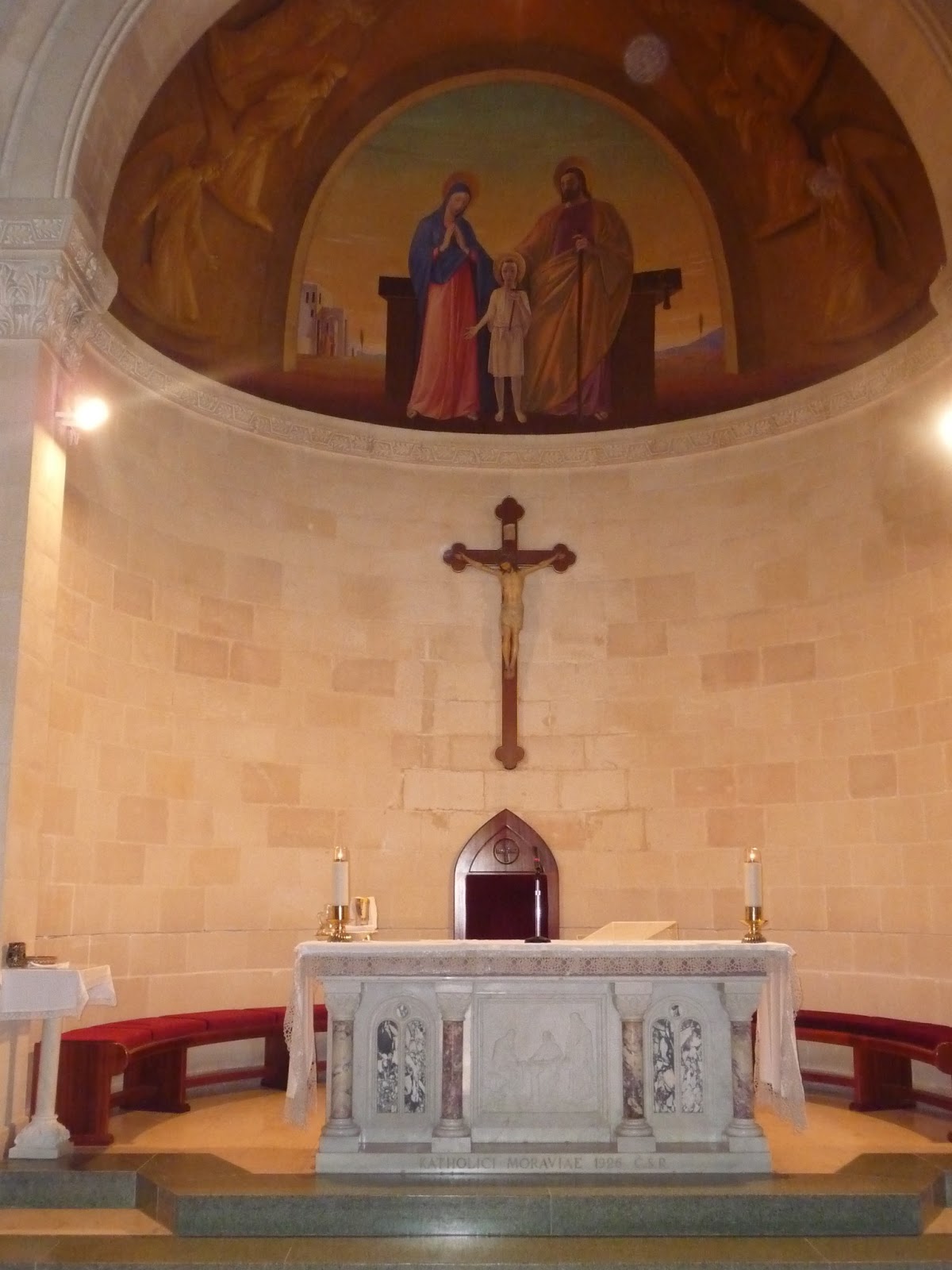
The altar of St. Joseph's Chapel. 
The Crypt under the chapel. 

Some random Italian asking for a blessing after Mass

The Basilica of the Annunciation 

St. Joseph, patron of a Holy Death, pray for us. 
The dome of the basilica is meant to look like a lily. 

Down below, in that small opening is what was originally Mary's house with numerous Church foundations surrounding the base - all from different periods 

Verbo Caro Hic Factum Est - the word was made flesh here. 
After our time in Nazareth, it was off the Megiddo, site of nearly 25 continuous civilizations as well as where the final battle is to take place - Revelation 16:16.


Having some fun on the chariot. 
A Canaanite altar for offering animal sacrifice.


A water system meant to give Megiddo's residence water even in the midst of war. 
Down, down, down. 

On the way down to the spring. 

And then we were off to the sea of Galilee. Here are beautiful pictures of a picturesque lake. 
Donnie Joe

Dennis and Joyce


 One of our group (a non-Catholic woman) asked to be baptized again at the Jordan river after she renewed her baptismal vows. She said the water was quite cold.

  And last, before going to our motel for the night, we visited a museum with remains of a 2 millenia old fishing boat, one Jesus might of used. There were some good replicas as well of what it looked like.